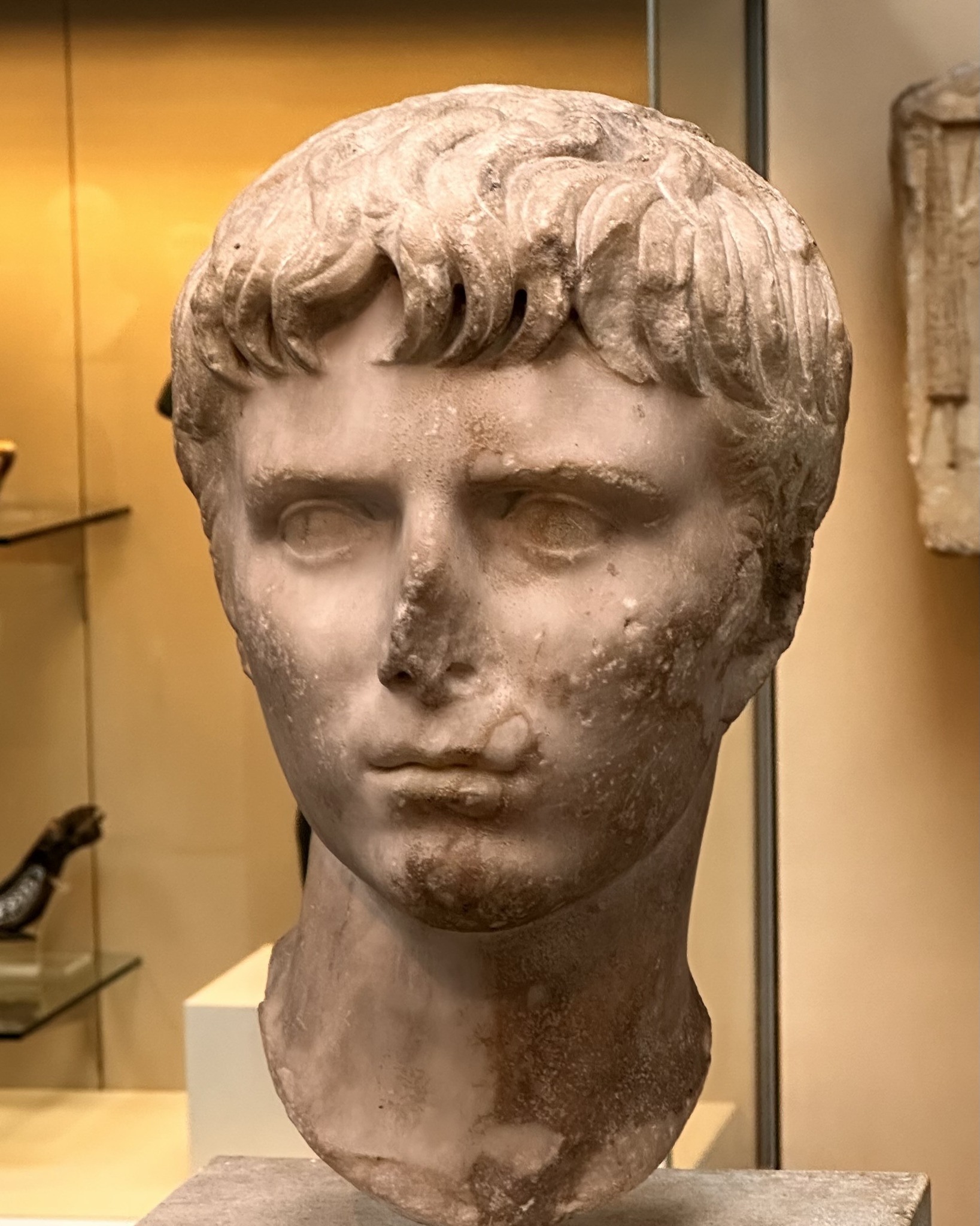
At a museum in Rome I took this picture of a head of Emperor Caligula (AD 37-41). With eerily familiar words, first-century Roman historian Suetonius describes Caligula’s rise to power:
“Upon his arrival in Rome the Senate and a crowd of people who had forced their way into the House immediately and unanimously conferred absolute power upon him” (The Twelve Emperors , Gaius 14).
From Suetonius and other ancient authors we get a sense of why John of Patmos, author of Revelation, declared that Roman emperors had become beastly.
Roman poet Virgil, praising Caesar Augustus (27 BC-AD 14), claimed that he was the one who “shall again set up the Golden Age” of Italy (Virgil, Aeneid 6.791). The Pax Romana! Everyone wanted to demonstrate alignment with the man wielding so much power.
Businesspeople in Asia Minor (region of the seven churches of Revelation) took an oath of absolute loyalty to Caesar and his family, declaring that “in defense of their interests I will spare neither body, soul, life, nor children” (Orientis graecae inscriptiones selectae 532).
Suetonius says popularity-seeking Emperor Caligula ordered “the dismissal of all criminal charges whatsoever” against a large number of people (Gaius 15). Caligula adopted a variety of vain titles, including “Best and Greatest of Caesars.” To visiting foreign dignitaries he quoted this line from Homer, “Nay, let there be one master, and one king!” (Gaius 22).
Caligula “had not the slightest regard for chastity, either his own or others” (Gaius 36), and craved wealth. Suetonius says that, “spilling heaps of gold pieces on an open space,” the emperor would “walk over them barefoot, or else lie down and wallow” (Gaius 42). He surrounded himself with fawning, incompetent advisors and considered appointing his favorite racehorse Incitatus to a senior government post (Gaius 55).
Emperor Nero (AD 54-68) similarly craved popular approval, and “boasted that no previous sovereign had ever realized the extent of his power” (Nero 37). “He lowered, if could not abolish, some of the heavier taxes” (Nero 10).
King Tiridates of Armenia journeyed to Rome and kowtowed to Nero, being made to “walk up a ramp and then prostrate himself in supplication” (Nero 13). People who did not bend the knee were vulnerable. “Punishments were . . . inflicted on the Christians, a sect professing a new and mischievous religious belief” (Nero 16).
A pandemic swept through Italy during Nero’s reign that brought “in a single autumn 30,000 deaths from plague” (Nero 39). The emperor’s “dominant characteristics were his thirst for popularity and his jealousy of men who caught the public eye” (Nero 53).
First-century emperors claimed to bring peace to the world, but in reality opened the way for Roman tycoons to get richer. After Rome subdued Britain in AD 83-84, indigenous chieftain Galgacus complained that the Romans were “Robbers of the world” who “plunder, butcher, steal.” They “make a desolation and call it peace” (Tacitus, Agricola 30).
Revelation 13:1-10 seems to address the vile reign of a specific first-century emperor—most likely Nero (AD 54–68). John says this ruler became beastly, by:
• assuming “blasphemous names” and roles, using religion to persuade for corrupt ends.
• reaching to “every tribe and people and language and nation” with his swaggering message.
• gaining fame by surviving a “death blow” and then having his “mortal wound” miraculously heal.
• holding humanity in his thrall as the “whole earth” follows him.
• convincing people that he is unstoppable, inducing subjects to ask, “Who is like the beast, and who can fight against it?”
In Revelation 13:11-18 John describes a second beast, which probably is the imperial cult, the empire-wide network of temples, choirs, and ceremonies that promoted emperor worship. John says this second beast:
• has “horns like a lamb” but speaks “like a dragon,” deceiving the world by appearing to be peaceful and comparable to the Lamb.
• spreads lies and disinformation as it “deceives the inhabitants of the earth.”
• “exercises all the authority of the first beast” and “makes the earth and its inhabitants worship the first beast, whose mortal wound had been healed.”
• creates an economic and political environment in which people who wish to succeed must show loyalty and wear the “mark” of the beast. “No one can buy or sell who does not have the mark.” This is not a literal tattoo (compare to Deuteronomy 6:4-9), but obsequious alignment with the beast’s agenda.
The directive Revelation 13 gives for Christians living under any beastly ruler is not violent resistance, because “if you kill with the sword, with the sword you must be killed.” Rather, John calls for “the endurance and faith[fulness] of the saints.”
From beginning to end, Revelation portrays and promotes steadfast worship of God and the Lamb as the indispensable spiritual and political anchor for followers of Jesus. Believers who “conquer” (chapters 2, 3) are those who remain faithful to the Lamb and reject lies of the beast.
When a political environment becomes idolatrous, followers of Jesus daily need to join the heavenly chorus, “Worthy is the Lamb that was slaughtered to receive power and wealth and wisdom and might and honor and glory and blessing!” (5:12). The Lamb confronted beastly power, the Lamb was slain—and then God changed the course of history by raising Jesus from the dead.
Rejecting nationalism and xenophobia, John calls on readers ancient and modern who know the risen Christ to celebrate citizenship in the global body of his followers, the “New Jerusalem” of Revelation 21 and 22.
The New Jerusalem is not just where we go when we die; it is the global community of those who honor Jesus and reject the idolatrous practices of/Rome. TheNew Jerusalem spiritually and politically embodies the Lord’s Prayer, “Thy kingdom come, thy will be done on earth as it is in heaven.”
Let anyone who has an ear listen to what the Spirit is saying to the churches.
 Holy Lands Peace Pilgrim