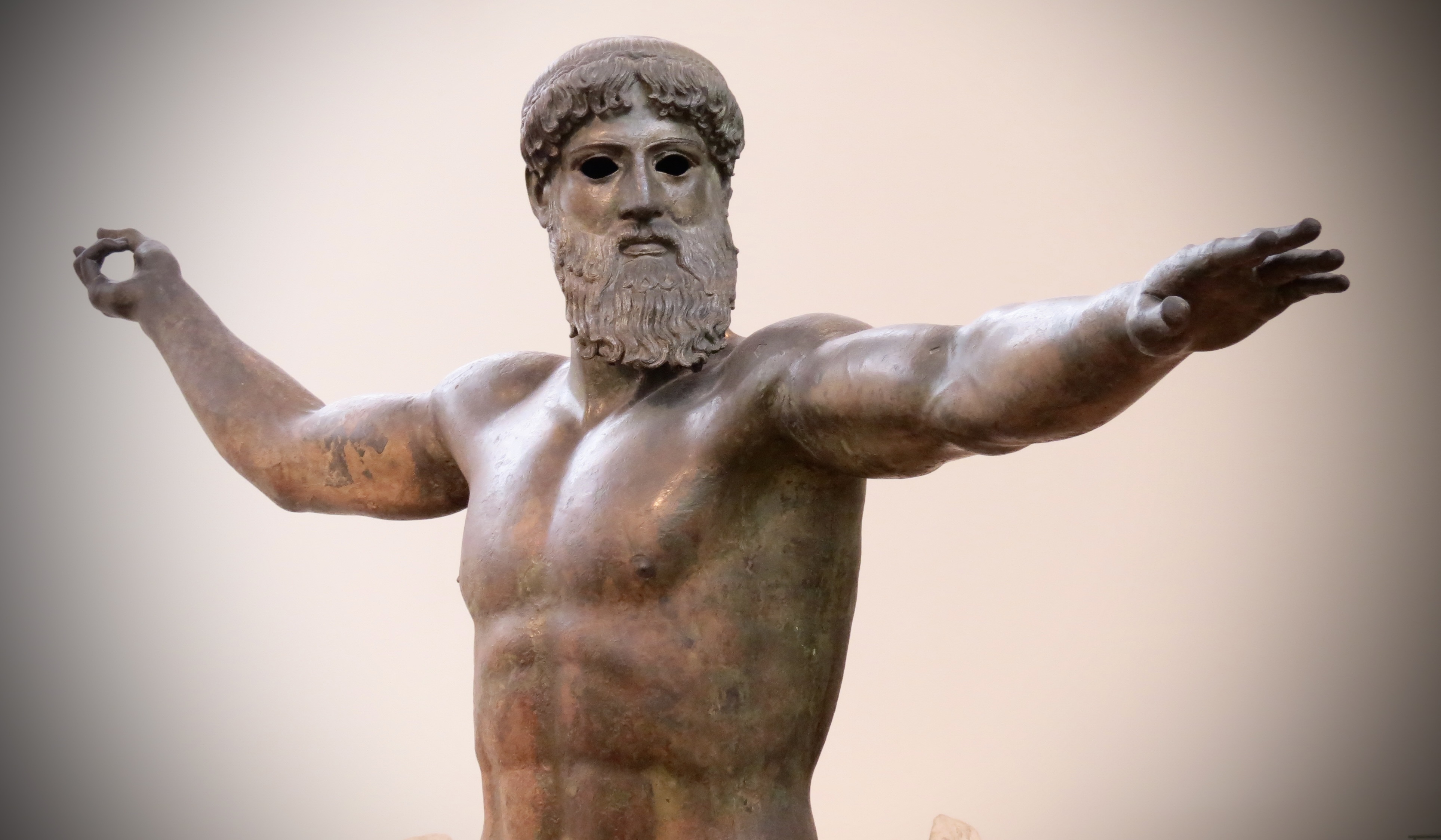
Whatever Zeus, chief of Greek gods, once held in his right hand was not friendly–either a lightening bolt or a spear. A little violence would solve whatever problem Zeus encountered.
I ponder the political and spiritual message of this oversized statue of Zeus (5th century BC) I saw a few years ago at the National Archaeological Museum in Athens, Greece.
Greek mythology repulses and captivates me. I’m repulsed by the way the gods (scores of them!) incessantly cheat, party, argue, fornicate, destroy, and meddle in human affairs. But since the gods so often act like humans, I’m captivated by the insight into relational failures, foibles, and follies that the ancient myths convey.
Homer’s Iliad culminates in a ghastly bloodbath at the end of the battle of Troy (12th century BC). Greeks—in cahoots with their gods—went into that battle certain that the bloody business would be over quickly. A little surgical violence would solve the conflict. But the Trojan war lasted for a terrible, exhausting decade.
Americans on both sides of the Civil War (1861-64) expected to settle that dispute in weeks if not days. In the 1960s, Americans, “paying any price for freedom,” were going to clean up communism in Vietnam in a hurry. In 2003 we heard “mission accomplished” with the surprisingly rapid fall of Saddam Hussein after the United States invaded.
All of these conflicts dragged on for years and generated vastly more death and destruction than any protagonists imagined.
Don’t buy talk today of quick victory in Iran with a “surgical” strike. Don’t be swayed by a commander-in-chief who uses “God, we love you” language while launching war.
Zeus-like violence might bring momentary pacification, but will not solve underlying problems. Americans destroyed democracy in Iran with a coup against a democratically-elected government in 1953, and in 2018 unilaterally withdrew from the “nuclear deal” in which Iran limited its nuclear capacity. The United States today is complicit with ongoing genocide in Gaza.
Repentance for American actions in the Middle East and hard work in diplomacy would be in order.
An ancient poet wrote that the God of the Hebrews “makes wars cease to the end of the earth . . . breaks the bow, and shatters the spear, and burns the shields with fire” (Psalm 46). We see the transforming power of this God in Jesus Christ, who laid down his life forgiving enemies, washing feet, conveying dignity on the marginalized and oppressed. “Put away your sword,” Jesus told his followers (Matthew 28).
All this is the hard, long-term work of peacemaking and reconciliation. A far cry from the rush to weapons so prevalent in Greek mythology and in American foreign policy.
____________________________________________________
P.S. For a vivid and accessible reimagining of Greek mythology, check out the bestselling series of four books by Stephen Fry entitled Heroes, Mythos, Troy, and Odyssey.
 Holy Lands Peace Pilgrim