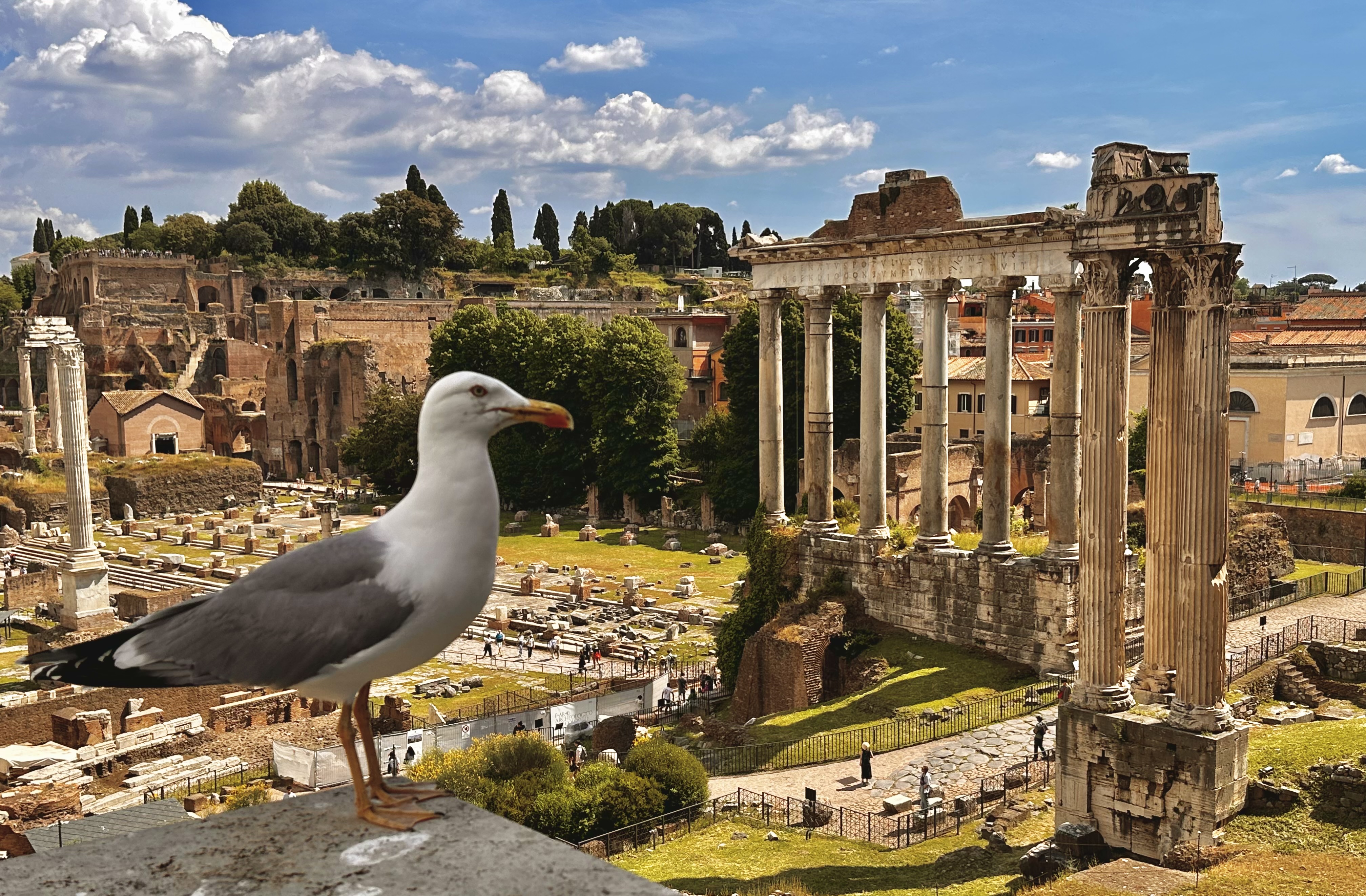
I took this picture of ancient Rome when Ellen and I visited the city in 2025. Today seagulls haunt what once was the epicenter of a sprawling empire. Rapacious emperors claimed to have made it great again. “I found Rome a city of bricks and left it a city of marbles,” boasted Caesar Augustus (Suetonius Divus Augustus 28.3).
Some people in exploited nations were not impressed. British chieftain Calgacus blasted the Romans for brutally subduing Britain in AD 83-85:
“Robbers of the world, now that earth fails their all-devastating hands, they probe even the sea: if their enemy have wealth, they have greed; if their enemy be poor, they are ambitious. . . To plunder, butcher, steal, these things they misname empire: they make a desolation and they call it peace” (Tacitus Agricola 30).
John of Patmos catalogued loot that Rome extracted from subject peoples:
“. . . gold, silver, jewels and pearls, fine linen, purple, silk and scarlet, all kinds of scented wood, all articles of ivory, all articles of costly wood, bronze, iron, and marble, cinnamon, spice, incense, myrrh, frankincense, wine, olive oil, choice flour and wheat, cattle and sheep, horses and chariots, slaves—and human lives” (Revelation 18).
“Human lives” comes last in this list. No worries if you kill forty or forty thousand if you gain sustained access to coveted resources.
Superpowers dominate and even invade other countries to gain access to resources, then claim that they brought peace. They unseat leaders of other nations and elevate indigenous lackeys who help exploit their own people. Imperial rulers surround themselves with gold, build palaces, put up triumphal arches, and demand unquestioned allegiance.
Biblical prophets blast such hubris. Ezekiel reminds the wealthy ruler of imperial Tyre that “you are a mortal, and not god. . . you have increased your wealth, and your heart has become proud . . . In the abundance of your trade you were filled with violence, and you sinned . . .” (Ezekiel 28). Tyre will fall!
John of Patmos derisively calls Rome “Babylon” and foresees the day when the greedy capital will become “a haunt for every foul spirit, a haunt for every foul bird” (Revelation 18:2). Rome will fall!
Seen seagulls around Washington, D.C. recently?
_______________________________________________
For full treatment of how Revelation deals with empire, see my book Apocalypse and Allegiance: Worship, Politics, and Devotion in the Book of Revelation.
 Holy Lands Peace Pilgrim