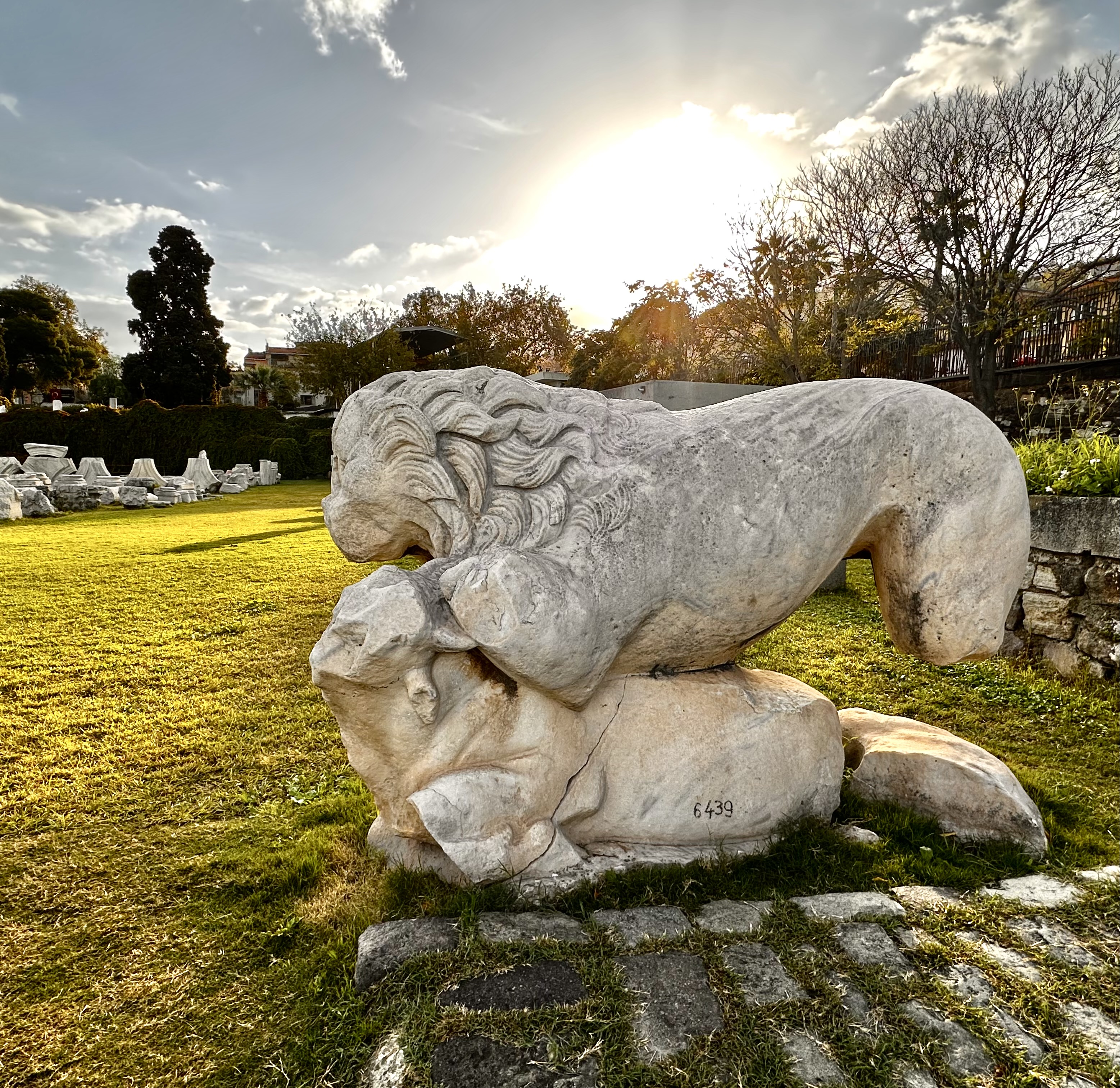
Nothing remains of a great stadium at Smyrna in Türkiye where a prominent early church teacher named Polycarp faced martyrdom on 23 February AD 155. But among ruins of ancient Smyrna, you will find this Roman-era statue of a lion devouring his prey—a reminder of how some early Christians perished.
The earliest account of Christian martyrdom outside of the New Testament is known as THE MARTYRDOM OF POLYCARP. A letter written by Christians at Smyrna to another congregation, it recounts terrible events at Smyrna stadium.
It was late in a day of “games” that included chariot races, gladiator fights, and executions. A Christian youth named Germanicus already had died when forced to “fight wild beasts.” A report reached the stadium of the detention of the great Christian teacher, Polycarp. People called him “the destroyer of our gods, who teaches many not to sacrifice or worship.” (Christians refused to venerate Greek gods or sacrifice to the emperor.)
Having just captured the 86-year-old Polycarp, city police were interrogating him outside the stadium. “What harm is there in saying ‘Caesar is Lord’ and offering incense and thereby saving yourself? . . . Have respect for your age! . . . Swear by the Genius of Caesar! Repent and say, ‘Away with the atheists!’” (Christians were called atheists because they did not believe in the gods.)
Authorities brought Polycarp into the stadium before a roaring multitude. Instead of condemning fellow Christians, he flipped the script, swept his hand across the great multitude and cried, “Away with the atheists! . . . For eighty-six years I have been Christ’s servant, and he has done me no wrong. How can I blaspheme my King who saved me?”
Emphasizing that Christians “pay proper respect to rulers and authorities appointed by God,” Polycarp offered to teach the “doctrine of Christianity” to the authorities if they would give him a hearing. Unimpressed, the provincial governor retorted, “I have wild beasts; I will throw you to them.” Replied Polycarp, “Call for them!”
The crowd demanded that a beast be released on the elderly man. But the master of ceremonies announced that scheduled “animal hunts” were over for the day, so Polycarp instead faced death by fire. As flames started, Polycarp prayed, “O Lord God Almighty . . . I bless you because you have considered me worthy of this day and hour . . .”
Members of the church at Smyrna—some apparently eyewitnesses—retrieved Polycarp’s bones, “more valuable than refined gold.” They said they hoped that “the Lord will permit us to celebrate the birthday of Polycarp’s martyrdom in commemoration of those who have already fought in the contest, and for the training and preparation of those who will do so in the future.”
Those who “would do so in the future” include Perpetua at Carthage, sixteenth-century Anabaptists of Europe, Dietrich Bonhoeffer in Germany, Archbishop Oscar Romero in El Salvador, Father Stanley Rother in Guatemala, Dr. Martin Luther King, Jr. in the United States, and countless others whose names we do not know. We can honor their “birthdays” into eternal life.
You and I may be spared the prospect of brutal martyrdom. But what does it mean for us that Jesus said, “If any want to become my followers, let them deny themselves and take up their cross daily and follow me.” (Luke 9:23)?
In today’s cacophony of idolatrous political loyalties, cult of personality, and blasphemous nationalism, what does it mean to give allegiance to Jesus the refugee, Jesus the immigrant, Jesus the marginalized? In the face of beastly realities, for what do I give my life today?
 Holy Lands Peace Pilgrim