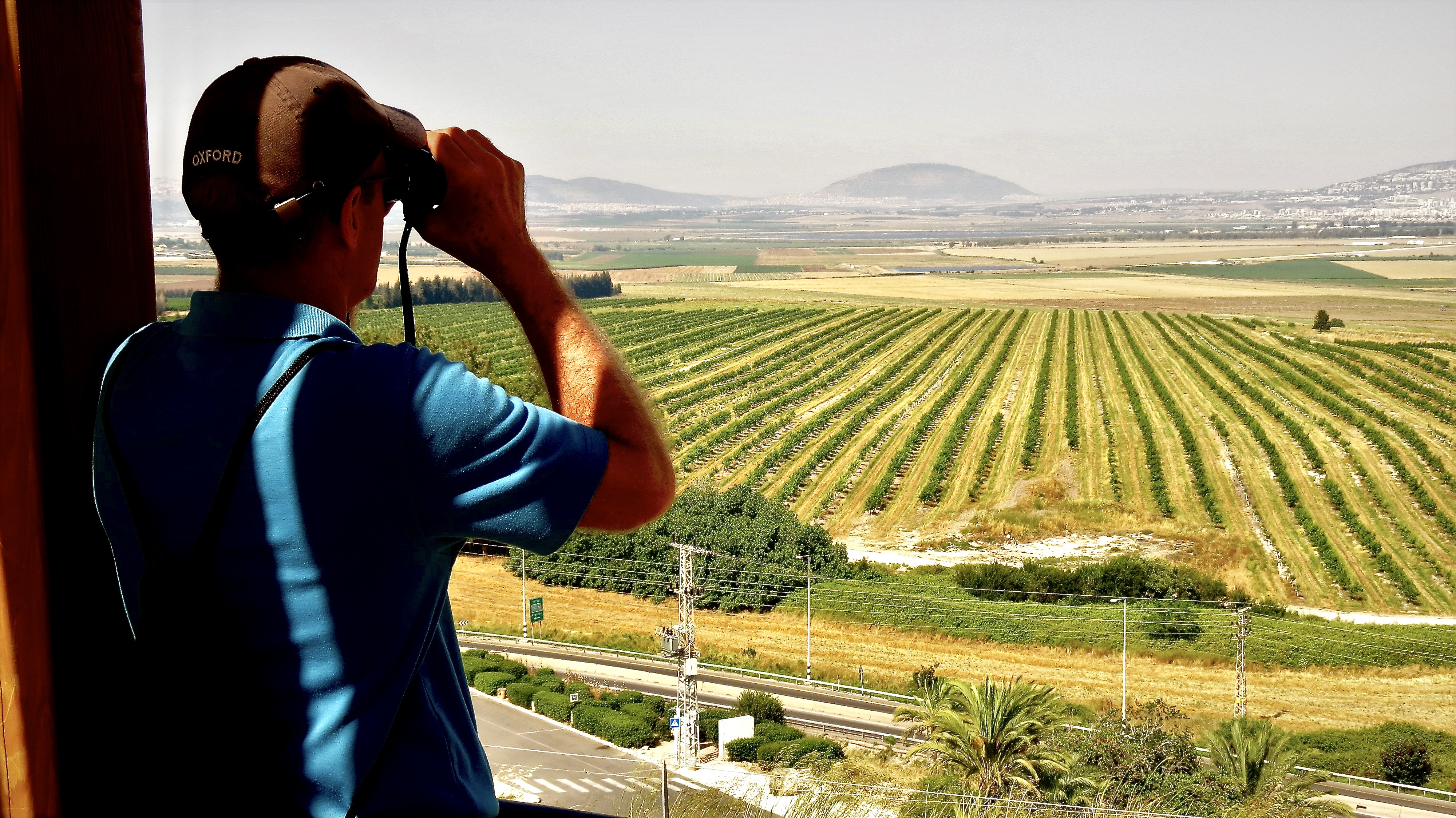
From the top of “Armageddon” (HAR MEGIDDO or “Mount Megiddo”) I took this picture of Jezreel Valley in northern Israel, where many so-called Bible prophecy advocates believe the final armed conflict of history will take place.
Today Megiddo is a large archeological mound made by ruins of at least twenty-six cities destroyed over thousands of years. It’s at the western entrance to Jezreel valley, the blood-soaked theater of countless battles. Top center on the horizon is Mt. Tabor, from which Deborah and fellow Israelites descended to defeat the Canaanite army of Sisera–who ended up with a tent peg through his temple (Judges 4). In this valley Pharaoh Neco killed Judean king Josiah in 609 BC (2 Kings 23). “Armageddon” epitomizes the blood and guts reality of war.
Revelation 16 says Satanic powers will assemble “kings of the whole world” here for a culminating battle on the “great day of God the Almighty.” Some Bible prophecy adherents conflate this battle with a Revelation 14 nightmare in which blood flows “as high as a horse’s bridle for a distance of about two hundred miles.”
“Premillennialists” (who believe Christ will return before his thousand-year millennial reign on earth) create schedules of end time events: Israel gets re-established (1948!); evil nations try to destroy it (just read the news!); Armageddon ensues (bring it on!); Christ returns (the “Rapture!”). Such scenarios are gratifying to adherents because they are on the winning side and get whisked off to heaven while planet Earth is in the agony of tribulation.
Do Christians who calendarize and even relish such projections know Jesus? After the resurrection, Jesus’ disciples asked him on the Mount of Olives if he was about to “restore the kingdom to Israel.” Was he about to bring regime change? Jesus was categorical in reply: “It is not for you to know the times or periods that the Father has set by his own authority. But you will receive power when the Holy Spirit has come upon you; and you will be my witnesses in Jerusalem . . . and to the ends of the earth” (Acts 1:6-8).
Get your minds off end-of-the-world speculation and begin carrying the good news of salvation to a broken world! Let God sort out details of how evil finally self-destructs. In the meantime, follow the teaching and example of Jesus in the present and work for reconciliation.
Revelation presents archetypes for understanding and responding to a warped FIRST CENTURY empire that had become beastly with power supplied by Satan. A second beast appears to be the global propaganda machine of emperor worship. The capital of the empire (Rome) is a harlot city that lures or coerces kings of the earth into the “fornication” of blasphemous loyalty. A vast new Jerusalem—apparently the church in mission—is taking form “on earth as it is in heaven.” All of this applies to FIRST CENTURY realities, but parallels for today are striking.
In reading accounts of travail in Revelation, it’s helpful to recall the plagues of Egypt. Their purpose was to get Pharaoh to repent and stop oppressing enslaved people. A similar summons to repentance may be the purpose of plagues in Revelation. Global suffering in Revelation begins with four standard “horsemen” of empire—conquest, slaughter, warped economy, death (Rev. 6:1-8). From there chaos spins the cosmos out of control with three series of seven plagues, each worse than the previous. Humans have started down a path that will upset even the orders of nature. Stars fall to earth, there is darkness and rivers of blood, horrible hail, environmental degradation, and much more. Embedded within these plagues is the horror of Armageddon.
It surprises a reader of the book of Exodus that Pharaoh did not repent and change course when he faced similar plagues. Perhaps the vision of seemingly endless plagues in Revelation simply gives warning to humanity that if they/we continue on the present course, things will become catastrophic. Not impossible to imagine in this era of global warming and nuclear threat.
Since John evidently had been deported to Patmos and fellow Christians were being killed, it makes sense that he may have been angry enough to wish awful things on Rome. Victims of war, deportation, occupation or sexual abuse might feel similar anger today. But should we take dark portions of the book of Revelation as divine prescription for what actually will or must happen?
Shouldn’t a battle of Armageddon be the LAST thing Christians would want or—God forbid—attempt to trigger? Even John of Patmos, with his cathartic anger at Rome, implies that people of the world can repent and change course (9:20, 21; 16:10-11). In the end, John sees something hopeful coming to earth: a vast New Jerusalem—the people of Jesus Christ—bringing a “healing of the nations” (22:2).
Follow the lamb, not the beast! Christ calls us to lay down our lives daily, in large or small ways helping to point humanity away from Armageddon, never toward it. We join God’s program of reconciliation. “For God so loved the world . . .”
++++++++++++++ For a thorough discussion of Christian responses to empire and violence, see Apocalypse and Allegiance: Worship, Politics and Devotion in the Book of Revelation (Baker, 2010).
 Holy Lands Peace Pilgrim