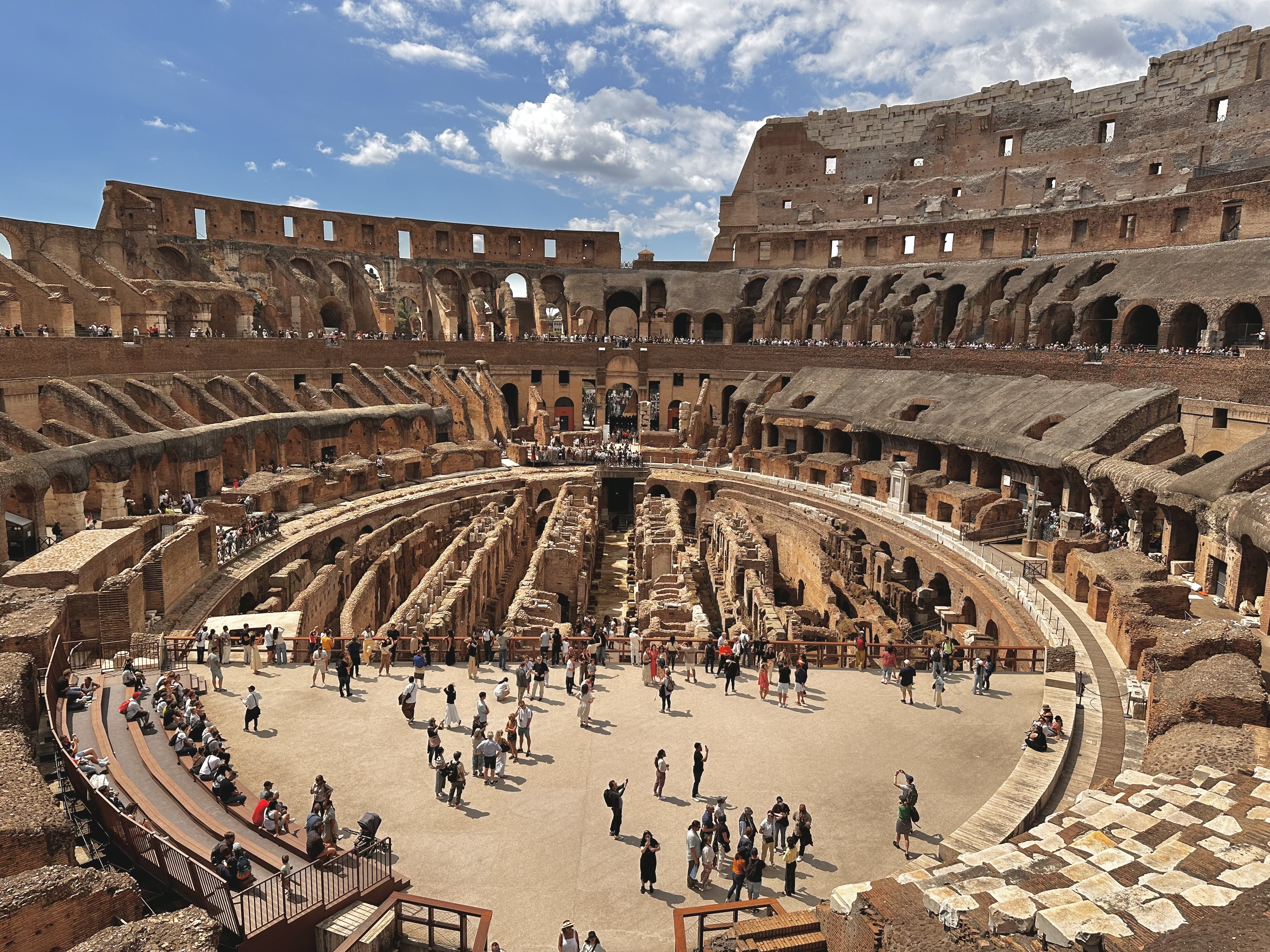
With Rome having just come through a polarizing civil war, Emperor Vespasian (AD 69–79) set out to distract the populace with ultimate fighting spectacles. He began building the Coliseum at Rome for gladiator “games” in AD 70. His son (Emperor Titus) completed the project in AD 80.
Step inside the Coliseum even today and it takes your breath away. Jewish prisoners of war (from the Jewish Revolt (AD 66–70) became forced labor this massive complex. Booty from the Jerusalem Temple complex—50,000 kg of gold and silver—funded construction.
The arena could accommodate 80,000 people. Elite males, Vestal Virgins, and prominent citizens who schmoozed the emperor got ringside seats. Plebians occupied upper tiers while women, poor people, and slaves took the nose-bleed sections.
Emperor Titus inaugurated the Coliseum in AD 80 with one hundred consecutive days of “games.” Some 2,000 humans and 9,000 animals died to entertain the masses. Titus and subsequent emperors routinely sponsored bloodsports here on religious holidays and especially on their birthdays.
Stoic philosopher Seneca of Rome (died AD 65), was an advisor to Emperor Nero who critiqued the barbarity of such bloodsports. Although some gladiators fought voluntarily and survived to become famous, most were convicts or captives brought out to face death as entertainment.
Seneca says he once went see such “games” but came home “more selfish, more self-seeking and more self indulgent . . . a person crueler and less humane.” He attended a mid-day exhibition, expecting “some light and witty entertainment.” He did not enjoy himself, complaining that “men are thrown to the lions and bears” and the only exit for contestants is death.”
When a criminal was brought out to die, Seneca says the crowds chanted, “Kill him! Flog him! Burn him! Why does he run at the other man’s weapon in such a cowardly way? . . . Why isn’t he a bit more enthusiastic about dying? Whip him forward to get his wounds!” (Seneca, Moral Letters to Lucilius 7)
The Apostle Paul uses Roman terminology of death-for-entertainment to describe the spiritual battles of Christians: “God has exhibited us apostles as last of all, as though sentenced to death, because we have become a spectacle to the world, to angels and to humans. We are fools for the sake of Christ” (1 Cor. 4;9,10).
Later, Paul spiritualizes gladiator fights (or soldiering) into a metaphor in which Christians “put on the whole armor of God.” Followers of Jesus struggle “against the rulers, against the authorities, against the cosmic powers of this present darkness . . .”
Paul says Christians shall “belt your waist with truth and put on the breastplate of righteousnes and lace up your sandals in preparation for the gospel of peace . . .” Believers “take the shield of faith . . . the helmet of salvation and the sword of the Spirit, which is the word of God” (Eph. 6:14-17).
With Paul wearing the “belt of truth” and committed to the “gospel of peace,” he would not have attended state-sponsored ultimate fighting spectacles.
Paul probably did not die in the arena. Ancient tradition says his earthly sojourn ended outside the city limits of Rome where Emperor Nero ordered him to be taken and beheaded in about AD 65.
+++++++++++++
[Coliseum photo copyright 2025 by J. Nelson Kraybill]

