Why do the most inept and authoritarian rulers want their names everywhere on monuments and buildings? Perhaps they know that, when they are gone, the sycophants and enablers who clustered around them will quickly disassociate themselves from the tyrant’s record. Bad rulers imagine that carving their name in stone will salvage some lasting glory for posterity.
But when corrupt or immoral Roman emperors died, people throughout the empire were likely to smash statues of the scoundrels and chisel their names off buildings and monuments. Though ancient people did not use the term, modern historians speak of this response as damnatio memoriae (“damnation of memory”).
Evidence from Ephesus
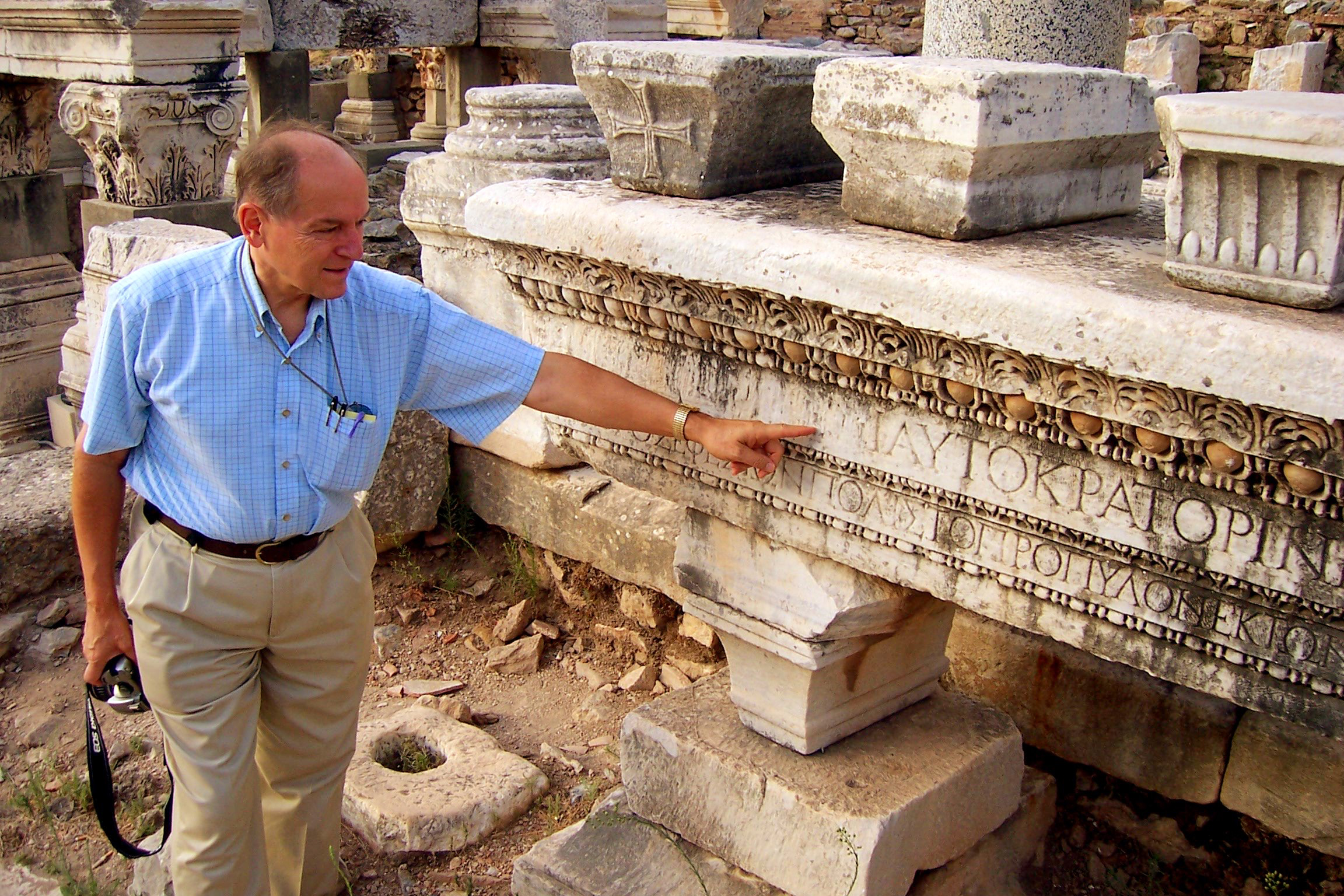
In the attached photo, which I took years ago at Ephesus, the late LeRoy Troyer points to a Roman inscription on which the name of a ruler has been removed. Presumably this is damnatio memoriae, likely for Domitian. He was the emperor who wanted to be called “Our lord and god.” A prophet named John–perhaps exiled to Patmos because he resisted such blasphemy––ascribed that title to God alone (Rev. 11:17, cf. John 20:28).
Note that to the right of Troyer’s hand the word AYTOKPATOP (“autocrat”) appears. This is the Greek translation of the Latin word for emperor. The Greek term literally means “self-ruler” or “one who rules by himself.” That in fact is how Roman emperors governed–as autocrats. If they were corrupt or inept or cruel, many in the empire could suffer.
The damnatio memoriae catharsis was a spontaneous expression of relief and revulsion. In the New Testament era it happened with three emperors, all of whom died violent death: Caligula (AD 37–41), Nero (AD 54–68), and Domitian (AD 81–96).
Unfit to rule
Cruelty and paranoia became hallmarks of the last years of Domitian’s rule. Senators who opposed him or somehow offended were put to death. The emperor killed people whom he accused of conspiracy.
When this demented ruler was assassinated in AD 96, contemporary historian Suetonius says Roman senators “thronged to denounce the dead Domitian . . . with bitter and insulting cries. Then, sending for ladders, they had his votive shields and statues hurled down before their eyes and dashed to the ground; and ended by decreeing that all inscriptions referring to him must be effaced, and all records of his reign obliterated” (Domitian 23).
Tyrants be advised
It was impossible to obliterate all evidence that a bad ruler existed. But at least damnatio memoriae could reverse the fawning adulation that surrounded him while in office. Senators and other enablers who did not have the backbone to say “no” to the autocrat while he was living at least could denigrate his memory when he was dead.
Tyrants be advised! Self-aggrandizing monuments and buildings you foist on a nation will not protect you from posthumous truth-telling by public opinion and historians.