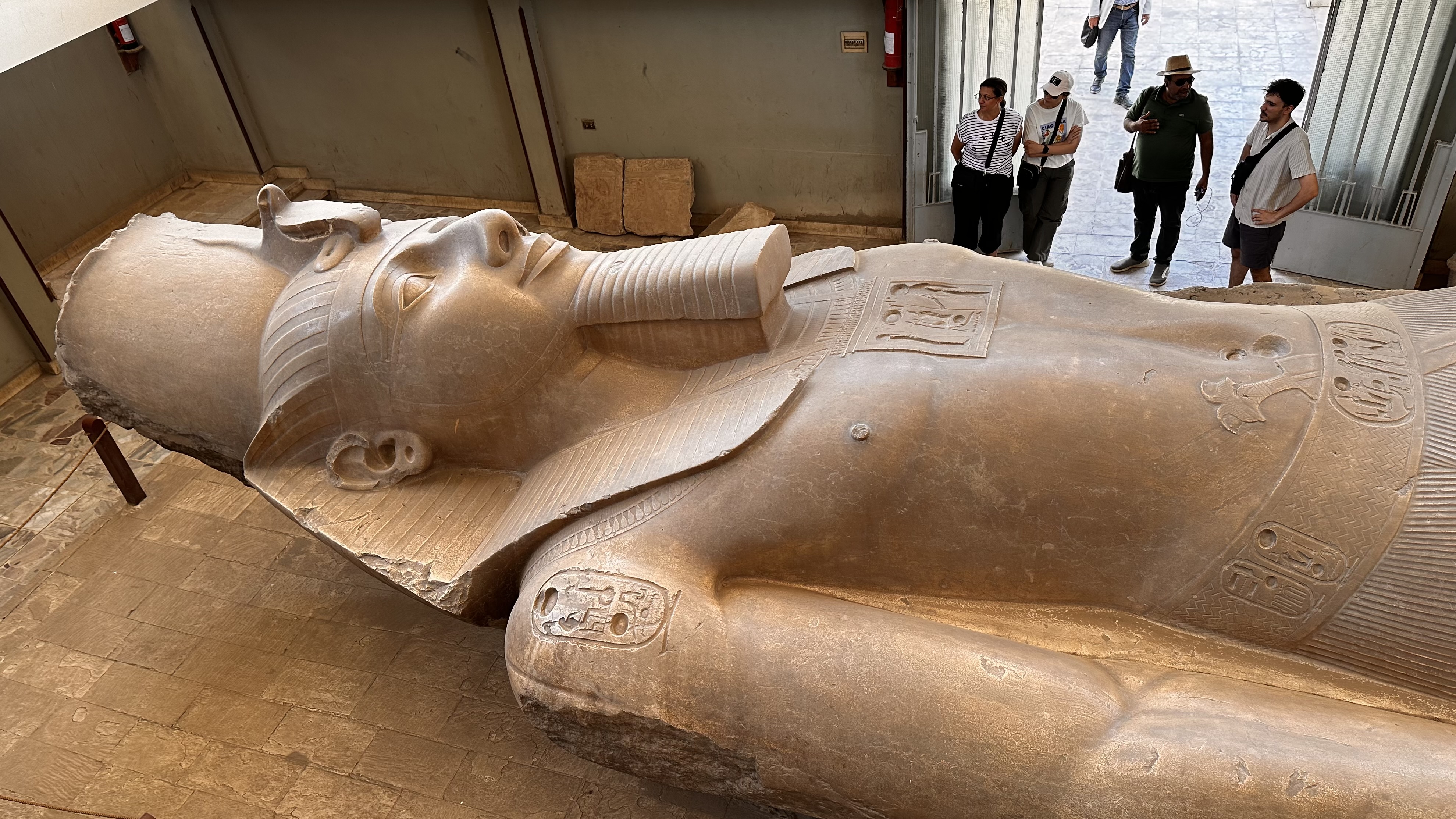
So, this is Ramses II, mighty Pharaoh of the Exodus! Today he lies flat on his back at Memphis, twenty kilometers south of the great pyramids in Egypt.
Arrogant and obsessed with his legacy, Ramses built more statues of himself than did any other Pharoah. This fallen statue at Memphis measures 33 feet, and a matching colossus of Ramses now stands upright at the Grand Egyptian Museum.
Never admitting defeat, throughout Egypt Ramses made bas relief images of himself annihilating foes. These typically show him smashing the skulls of enemies or running them down with his war chariot.
Ramses unwisely went to war with the Hittites and soon found his army “outmaneuvered, ambushed, and surrounded,” as one historian puts it, at Kadesh. Ramses called this battle a great success, but historians call it a stalemate.
A world-class narcissist, Ramses slapped his name—still visible today—on multiple temples and palaces of his predecessors. With a propaganda technique that later autocrats would copy, Pharoah fostered fear of foreigners within.
When Joseph had risen to power centuries earlier, he and the Pharaoh of that era warmly welcomed Israelites to live and work in Egypt (Genesis 46–50). They arrived under what we might call Temporary Protected Status. But now Ramses “set taskmasters over them to oppress them with forced labor.”
Using we/them language that sounds familiar today, Ramses promoted an early version of the Great Replacement theory. “Look,” he said, “the Israelite people are more numerous and more powerful than we. Come, let us deal shrewdly with them, or they will increase and, in the event of war, join our enemies and fight against us and escape from the land” (Exodus 1:9-14).
Lacking ankle monitors and black vans to intimidate immigrants, Pharaoh tried to work them to exhaustion. A manic builder of monuments, temples, and palaces, Ramses compelled the Israelites to build imperial supply cities at Pithom and Rameses in the Nile Delta. Finally, he turned to genocide and ordered the slaughter of Israelite baby boys.
Beleaguered immigrants cried out to God, who summoned Moses. “I have heard their cry and . . . I know their suffering, and I have come down to deliver them . . .” (Exodus 3:7).
Delivery came through a ten-plague struggle. It ended with Pharaoh’s army chasing the Israelites across the Reed Sea—a swampy area east of the Nile Delta where winds can sweep back the waters and sweep them in again.
Moses and the Israelites sang to the Lord, “You blew with your wind, the sea covered them; they sank like lead in the mighty waters.” Pharaoh’s “picked officers . . . went down to the depths like a stone” (Exodus 15).
Evidently Ramses himself did not go to the bottom, but his reputation did. Jews, Christians, and Muslims remember him largely for his cruelty and willful disobedience of God.
Abusers of power be advised! Moses and his sister Miriam (Exodus 15:21) could tell you that God aligns with the oppressed, the suffering, the immigrant. God is still paying attention.
_________________________
Would love to have you join me for a tour of Egypt and Jordan named “Bread for the Journey: Sacred Landscapes of Egypt & Jordan” in October, 2027. See https://www.tourmagination.com/tours/bread-for-the-journey
Or, join a tour in May, 2027 entitled, “Living Hope, A Journey with Early Christians in Türkiye: Exploring Faith and Culture in the World of Early Followers of Jesus.” See https://www.tourmagination.com/tours/living-hope-a-journey-with-early-christians-in-trkiye

