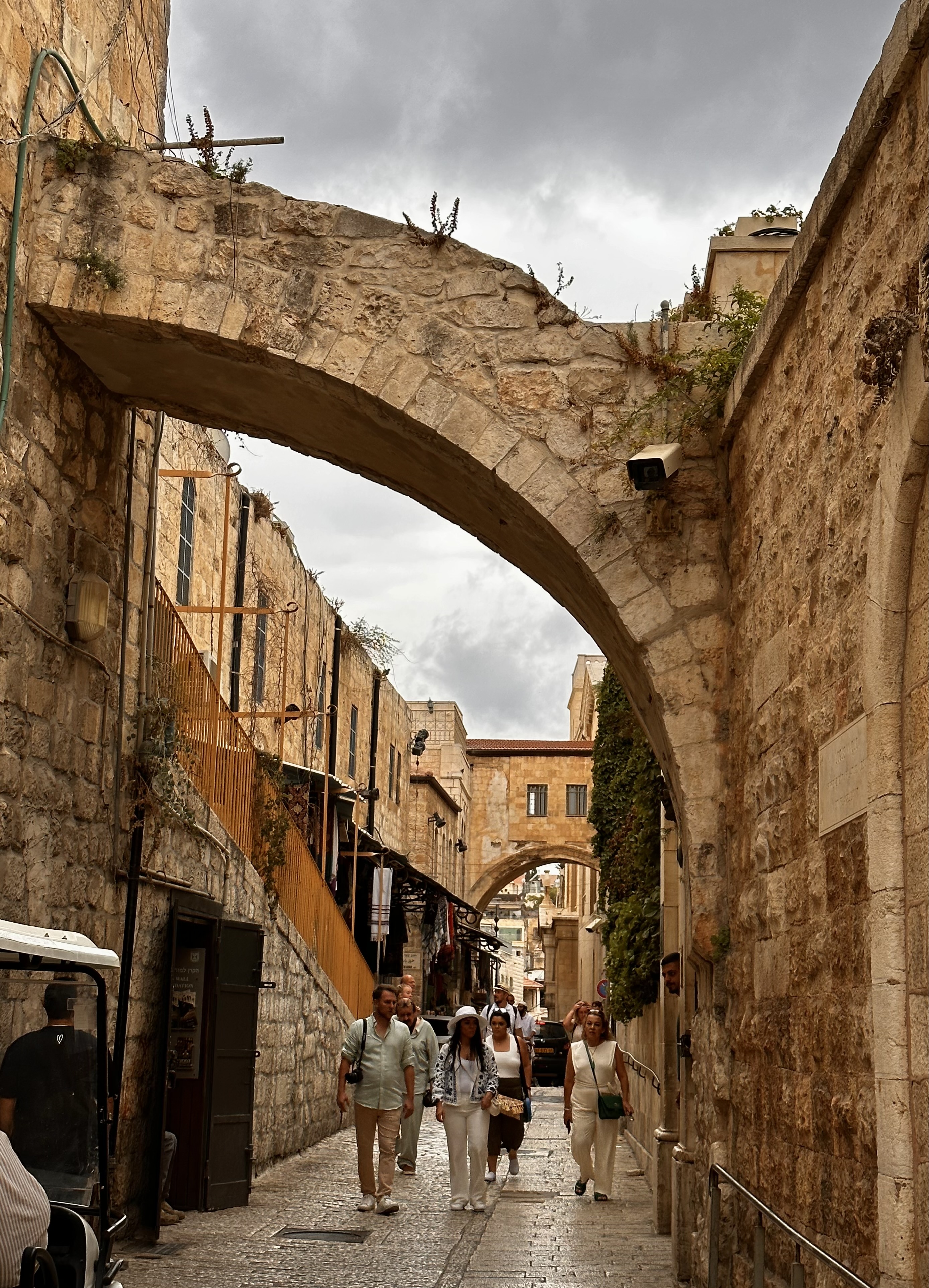
The above photo shows the Via Dolorosa (“way of suffering”) in Jerusalem. Down this street, by tradition, Jesus carried the hundred-pound crossbeam for his cross of agony. This often-crowded street is the sort of venue Rome wanted for parading to an execution. Crucifixion was intended to be public, sadistic, and humiliating.
It is a hallmark of repressive governments to use public execution to intimidate opposition and to compensate for lack of moral authority. “Don’t mess with us; we could do this to you!”
State terrorism was rampant in the New Testament era, when crucifixion by Rome was common. It did not happen “on a green hill faraway,” and it was not pretty. The whole purpose of crucifixion was to put ghastly retribution on public display, up close and personal.
Golgotha in Jesus’ day was part of a small stone quarry immediately outside the Jerusalem city walls. Jesus “suffered outside the city gate,” the author of Hebrews says (13:12). Jesus died along a busy road where hundreds or thousands passed daily. Horror was the object.
In 73 BC, Rome put down a slave revolt in Italy and crucified six thousand men. Crosses lined both sides of the Appian Way, a main highway into the imperial capital, for miles. Bodies rotted in the sun for months. Reports of this outrage long triggered revulsion throughout the empire.
In 63 BC, Roman orator Cicero told the judge at a murder trial that “the very word ‘cross’ should be far removed not only from the person of a Roman citizen but from his thoughts, his eyes and his ears” (Pro C. Rabirio Perduellionis Reo 16). Crucifixion, he said, “cannot by any possibility be adequately expressed by any name bad enough for it” (Against Verres 66).
Public execution was a psychological weapon, designed to deter others from repeating the offense (often accusation of subversion or insurrection). It was an attempt to cow subjected people into submission.
Most Christians before the fourth century opposed capital punishment. Hippolytus (AD 165–235), church elder at Rome, recognized that some persons became Christian while in the army. But “a military man in authority must not execute men,” Hippolytus said. “If he is ordered, he must not carry it out” (Apostolic Tradition 16.9).
Theologian and author Tertullian (AD 160–220) of North Africa said God “puts his interdict on every sort of human-killing” (On the Shows 2). Like most early Christians, Tertullian rejected the taking of any human life in any form, whether by war, in gladiator fights, by capital punishment, by “exposure” of newborns, or by abortion.
Christians should not attend chariot races or other sports events where executions happened, said Christian teacher Athenagoras of Athens (AD 133–190). “To see a man put to death,” he declared, morally “is much the same as killing him” (“A Plea for the Christians,” 35).
When Emperor Constantine legalized Christianity in the fourth century, the empire did not become Christian. The church became imperial, endorsing state violence in warfare and in capital punishment. In that trade-off Christians lost something essential of the mercy and compassion of our Lord.
What execution would Jesus support or even watch?
***********************
Wish to travel to biblical sites in the Mediterranean world? Join a pilgrimage journey with me in 2027! See: https://www.tourmagination.com/faith-history

